Month: June 2016

Why Strong Boxes Reduce Customer Complaints

Customer complaints rarely start with the product alone. More often, they begin with how the product arrived. Shipping boxes play a major role in shaping that experience.

When a box shows up crushed or damaged, customers expect the worst. They open it cautiously, already frustrated. Even if the product survives, the negative feeling stays.

Weak shipping boxes create unnecessary problems. Thin walls bend under pressure. Corners collapse when stacked. Seams split when tape can’t compensate for poor construction. Each failure increases the chance of a complaint.

Carriers move packages through rough conditions. Boxes get stacked under heavier shipments. They slide across belts. They’re handled quickly and repeatedly. If a box isn’t built for that environment, it won’t hold up.

Strong shipping boxes resist those forces. They keep their shape. They protect corners. They hold seams together. When the box survives, the product inside is far more likely to survive too.

Many businesses try to offset weak boxes with extra tape or extra fill. While that may help in the short term, it slows down packing and raises costs. It also signals that the box itself isn’t doing its job.

Good shipping boxes simplify packing. They don’t need reinforcement. They fold cleanly. They seal easily. Staff can work faster without worrying about failure.

Customer complaints cost more than most people realize. They take time to resolve. They require replacements or refunds. They damage trust. Even when handled well, complaints leave a mark.

Reducing complaints starts with prevention. Strong shipping boxes prevent damage before it happens. They reduce the situations that trigger frustration in the first place.

There’s also a visual element. Customers judge care based on appearance. A crushed box suggests neglect. A solid box suggests professionalism. That judgment happens instantly.

Strong boxes also reduce internal stress. Fewer damaged shipments mean fewer interruptions. Customer service handles fewer issues. Fulfillment teams spend less time fixing mistakes.

As order volume grows, the impact of box quality multiplies. What fails occasionally at low volume fails frequently at scale. Complaints increase. Costs rise. Growth slows.

Choosing strong shipping boxes early creates stability. It supports growth without adding friction. It protects both products and reputation.

Shipping boxes don’t get credit when things go right. They only get noticed when they fail. That’s why failure prevention matters more than recognition.

When boxes do their job well, customers stay focused on the product, not the problem. Complaints stay low. Trust stays intact.

That’s the quiet value of strong shipping boxes. They reduce issues most customers never see, and that’s exactly the point.

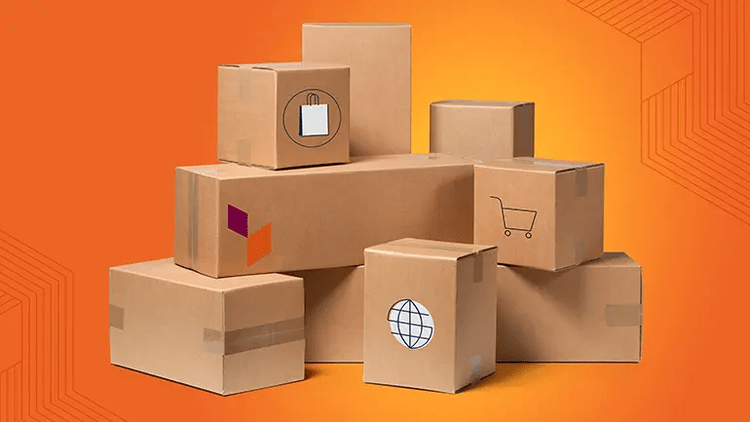
Optimizing the Ecommerce Packaging for Tariffs in Shipping 

Understanding your tariffs is important, especially if you ship in the UK. This is determined by the size and weight of the package, and different couriers will actually have different pricing and criteria. 

This is a tariff that isn’t just the costs based on packages, but also influences the decisions for operation, especially distribution and management of stock.

Analysis of the different Tariff Structuring 

Every courier does have unique structures for their tariffs. 

Royal mail for instance is influenced primarily by the weight and size, with specific categories for small parcels, letters, and bigger packages. 

The DPD does focus on the dimensions and weight, but there is a maximum limit to help accommodate the logistics. 

UPS caters to an overall global market and has a very comprehensive system. It does accommodate larger and heavier packages. However, there are restrictions on the costs for items that are oversized. 

Finally, the Evri, known formally are Hermes, does have size limits that are better for smaller types of parcels, so a lot of smaller businesses prefer this one.

Dimensions and Tariffs 

The packaging dimensions do impact the costs of shipping. A heavier and larger type of package does  generally incur a higher cost. This correlation does make it imperative to have a business properly optimize the packaging. 

For instance, even just reducing a couple of grams or centimeters does shift packages into lower brackets for tariffs, and leads to major savings, especially when properly scaled across thousands of shipments. 

Tariffs for Royal Mail 

You’ll probably use royal mail in the UK, especially since this is the main system for parcels.   There is a tariff system for letters and packages too. This cost is determined by the size, weight, and the service type. These tariffs are important. Large parcels can not weight more than 30 kg or 1.5 meters in length, and a combined thickness and depth of 3 meters. 

The letters do vary but are usually a couple euros. Small ones are about 4 for first class, and for second glass, it’s about 3 bucks, give or take. 

DPD shipping 

If you’re going to use DPD, you should know that there is specific criteria for this. This is because a lot of parcels cannot weigh more than 31.5 kg to be shipped. The size should not be more than 3 meters, with the girth and the longer sides included. The length is restricted to only 1.75 meters in size. You should calculate your shipping to make sure that you can fit your packaging in DPD if you choose to use it. 

UPS Shipping 

UPS is another important logistics leader and has their own rules for packaging shipments. 

When you package with UPS, you do need to bear in mind that parcels can weigh around 70 kg, which is a lot more, and the length is up to 274, but no combined length that’s larger than 400 centimeters. Most of the packages that are more than 25 kg do require a special label, and it’s a larger or heavier type of package that might require specific freighting. Understanding is good for packaging optimization, ensuring that there are shipping solutions which are cost effective. 

When using this, you need to be mindful of just how much you’re going to have to pay. Properly adapt to these and make sure that you do reduce this as much as you can, in order to implement the solutions that will reduce the weight and size, leading to huge savings and allowing for products to fit more within an economical type of shipping bracket. It optimizes, saving you thousands, and bolstering sustainability that comes with this as well.